
The core beliefs of Islam are belief in one God (Allah), His angels, His books, His messengers, the Day of Judgment, and divine decree (Qadr).

×
Understanding Islam Core Beliefs
What Is Islam?
The word “Islam” comes from the Arabic root S-L-M, which signifies peace, submission, and safety. Religiously, Islam is the complete surrender of one’s will to ALLAH and adherence to His guidance as revealed in the Quran and exemplified by the Prophet Muhammad (ﷺ). Islam is a religion in the sense that it provides structured guidance for belief, worship, ethics, and community life. At the same time, it is a way of life, directing personal behavior, social responsibilities, and spiritual development. It is not tied to ethnicity or nationality, answering the question, “is Islam an ethnic religion?” with a clear no. Islam is universal, open to all who embrace its teachings sincerely.
Qari for Kids offers a structured, interactive, and child-friendly platform for young learners to study the Quran from the comfort of their homes. With experienced tutors, one-on-one attention, and a curriculum that includes Noorani Qaida, Tajweed, and Quran memorization, our program is designed to suit the unique needs of every child.
Whether you’re looking to build a strong Islamic foundation, ensure proper pronunciation through Tajweed, or simply make Quran learning more engaging and consistent, online learning is proving to be a safe, effective, and convenient choice for today’s Muslim families.
The Core Beliefs of Islam
Sunni Islam emphasizes six foundational articles of faith (Iman) that every believer affirms.
1. Belief in ALLAH
The cornerstone of Islamic faith is Tawheed, the oneness of ALLAH. Belief in ALLAH alone, without associating partners with Him, is the essence of Islam. The Quran says:
"God is ˹only˺ One God. There is no god ˹worthy of worship˺ except Him—the Most Compassionate, Most Merciful."
- Surah Al-Baqarah, 2:163
2. Belief in Angels
Angels are pure, obedient creations of ALLAH, fulfilling assigned duties. The Quran mentions:
"All praise is for ALLAH, the Originator of the heavens and the earth, Who made angels ˹as His˺ messengers with wings—two, three, or four. He increases in creation whatever He wills. Surely ALLAH is the most capable of everything."
- Surah Fatir, 35:1
3. Belief in Divine Books
ALLAH revealed guidance through scriptures: the Torah, Psalms, Gospel, and the Quran. Among these, the Quran is the final and preserved revelation:
"Verily We: It is We Who have sent down the Dhikr (i.e. the Quran) and surely, We will guard it (from corruption)."
- Surah Al-Hijr, 15:9
4. Belief in Prophets
Prophets are chosen to convey ALLAH’s message. The Quran states:
"Indeed, We sent messengers before you ˹O Prophet˺ among the groups of early peoples."
- Surah Al-Hijr, 15:10
Narrated Abu Huraira:
The Prophet (ﷺ) said, "The Israelis used to be ruled and guided by prophets: Whenever a prophet died, another would take over his place. There will be no prophet after me, but there will be Caliphs who will increase in number." The people asked, "O ALLAH's Messenger (ﷺ)! What do you order us (to do)?" He said, "Obey the one who will be given the pledge of allegiance first. Fulfil their (i.e. the Caliphs) rights, for ALLAH will ask them about (any shortcoming) in ruling those ALLAH has put under their guardianship."
- Sahih al-Bukhari 3455
5. Belief in the Day of Judgment
The Day of Judgment emphasizes accountability. The Quran says:
"So whoever does an atom’s weight of good will see it, and whoever does an atom’s weight of evil will see it."
- Surah Al-Zalzalah, 99:7-8
Belief in this day encourages ethical behavior, honesty, and moral responsibility.
6. Belief in Divine Decree (Qadar)
Sunni scholars affirm that ALLAH knows and decrees all things. Human beings have free will, yet everything occurs under ALLAH’s knowledge:
"Say, “Nothing will ever befall us except what ALLAH has destined for us. He is our Protector.” So in ALLAH let the believers put their trust."
- Surah At-Tawbah, 9:51
Acknowledging divine wisdom fosters trust in ALLAH, patience in adversity, and contentment in life.
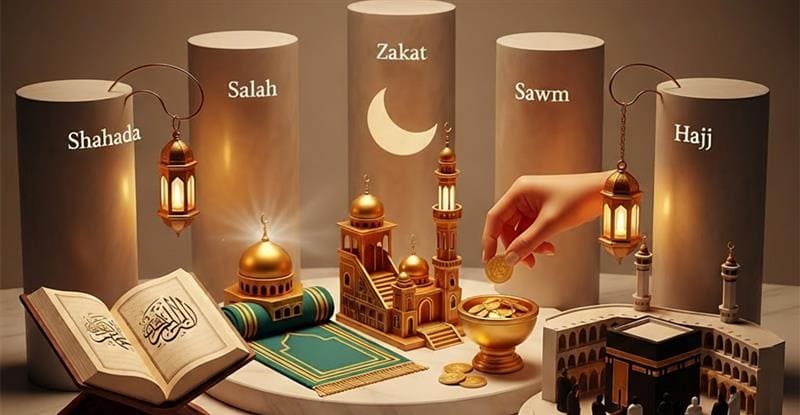
The Five Pillars of Islam
Faith in Islam is incomplete without practice. The Five Pillars of Islam provide the practical framework for a Muslim’s life, guiding spiritual, ethical, and social behavior. Each pillar is supported by authentic Quranic verses and Hadiths.
1. Shahada (Declaration of Faith)
The Shahada is the testimony that there is no god except ALLAH and that Muhammad (ﷺ) is His Messenger. It is the fundamental statement of faith that unites all Muslims.
It affirms monotheism (Tawheed) and acknowledges the finality of Prophethood. By declaring the Shahada, a person enters the fold of Islam.
Say, ‘He is ALLAH, [who is] One. ALLAH, the Eternal Refuge. He neither begets nor is born, nor is there to Him any equivalent.’
- Surah Al-Ikhlas, 112:1-4
The Prophet Muhammad (ﷺ) said:
Verily, whoever testifies there is no God but ALLAH, then ALLAH will forbid him from entering Hellfire and require him to enter Paradise.
- Sahih Ibn Hibban 199
2. Salah (Prayer)
Salah is the formal prayer performed five times daily at prescribed times: Fajr, Dhuhr, Asr, Maghrib, and Isha. Prayer establishes a direct connection between the believer and ALLAH, fostering discipline, mindfulness, and spiritual growth.
It affirms monotheism (Tawheed) and acknowledges the finality of Prophethood. By declaring the Shahada, a person enters the fold of Islam.
And establish prayer and give zakah and obey the Messenger – that you may receive mercy.
- Surah An-Nur, 24:56
It was narrated from Tamim Dari that the Prophet (ﷺ) said:
The first thing for which a person will be brought to account on the Day of Resurrection will be his prayer. If it is complete, then the voluntary (prayers) will also be recorded for him (as an increase). If it is not complete then ALLAH will say to His angels: ‘Look and see whether you find any voluntary prayers for My slave, and take them to make up what is lacking from his obligatory prayers.’ Then all his deeds will be reckoned in like manner.
- Sunan Ibn Majah 1426
3. Zakat (Almsgiving)
Zakat is obligatory charity, usually calculated as 2.5% of a Muslim’s accumulated wealth annually. It purifies wealth, assists the poor and needy, and ensures social equity. It reminds Muslims of their responsibility to care for the less fortunate.
Take from their wealth ˹O Prophet˺ charity to purify and bless them, and pray for them—surely your prayer is a source of comfort for them. And ALLAH is All-Hearing, All-Knowing.
Surah At-Tawbah, 9:103
4. Sawm (Fasting during Ramadan)
Sawm is the abstention from food, drink, sexual relations, and sinful behavior from dawn to sunset during the month of Ramadan. Fasting cultivates self-discipline, empathy for the poor, spiritual reflection, and closeness to ALLAH.
The month of Ramadhan [is that] in which was revealed the Qur’an, a guidance for the people and clear proofs of guidance and criterion. So whoever sights [the new moon of] the month, let him fast it; and whoever is ill or on a journey – then an equal number of other days. ALLAH intends for you ease and does not intend for you hardship and [wants] for you to complete the period and to glorify ALLAH for that [to] which He has guided you; and perhaps you will be grateful.
(Surah Al-Baqarah, 2:185)
5. Hajj (Pilgrimage to Mecca)
Hajj is the pilgrimage to the holy city of Mecca, required at least once in a lifetime for every Muslim who is physically and financially able. It fosters equality, unity, and devotion to ALLAH. It commemorates the actions of Prophet Ibrahim (Abraham) and his family, reflecting submission and faith.
Narrated Abu Huraira:
The Prophet (ﷺ) said, "Whoever performs Hajj for ALLAH's pleasure and does not have sexual relations with his wife, and does not do evil or sins then he will return (after Hajj free from all sins) as if he were born anew."
- Sahih al-Bukhari 1521
Key Takeaways
- These Five Pillars collectively structure a Muslim’s spiritual and social life.
- They link faith with action and personal devotion with community welfare.
- They form the foundation of a balanced, ethical, and purposeful life according to Islamic teachings.
Addressing Common Questions
Is Islam Muslim?
Islam is the faith; a Muslim is one who submits to ALLAH and follows His guidance.
Is Islam a Religion?
Yes. Islam provides structured guidance for belief, worship, and moral conduct.
Introduction to Islam
Islam teaches submission to ALLAH, moral responsibility, and ethical conduct. Reflection, prayer, charity, and obedience cultivate spiritual growth.
Important Facts About Islam
- Islam promotes peace, mercy, and justice.
- The Quran is preserved and unaltered.
- Hadith literature explains the Prophet’s (ﷺ) guidance.
- Celebrations include Eid al-Fitr and Eid al-Adha.
- Islam recognizes previous prophets, promoting respect for other Abrahamic faiths.
Practical Steps to Understand Islam
1. Read the Quran with trusted Tafsir for context.
2. Study authentic Hadith from collections such as Sahih Bukhari and Sahih Muslim.
3. Attend Islamic lectures at reputable centers.
4. Seek guidance from qualified Sunni scholars.
5. Apply teachings in daily life, practicing prayer, charity, honesty, and ethical behavior.
“For young learners, following a Qari for Kids can help cultivate correct Quranic recitation and understanding, laying a strong foundation for lifelong engagement with the Quran.”Conclusion
Islam is submission to ALLAH, guided by the Quran and Sunnah, encompassing faith, worship, and ethics. Its six articles of faith and five pillars structure a Muslim’s spiritual and social life.
Whether seeking an introduction to Islam, an Islam overview, or important facts about Islam, understanding the faith through Quranic teachings and authentic Hadith ensures a comprehensive, authentic, and respectful approach.
Islam is a universal faith, open to all who sincerely submit, guiding billions toward a life of justice, compassion, and spiritual fulfilment.
Frequently asked questions
-
What are the core beliefs of Islam?
-
Why is understanding Islamic beliefs important?Understanding Islamic beliefs helps Muslims strengthen their faith, live according to divine guidance, and develop a deeper spiritual connection with Allah.
-
How can children learn about Islamic beliefs?Children can learn through interactive online Quran classes, Islamic stories, and daily lessons that explain each belief in a simple and engaging way.
